Moss treatment in Wellington: soft wash, spray, or scrape, which actually works?
Wellington's damp climate grows moss faster than almost anywhere in NZ. Three treatment methods, which one fits your roof and walls, what each costs, and how long results last.
Wellington has one of the highest moss-growth rates in NZ. Three treatment methods are common: biocide soft wash, residual spray, and manual scrape. They're not interchangeable.
For most Wellington roofs and walls, biocide soft wash is the right answer. Scraping is for one specific case (heavy lichen on Coloursteel). Residual sprays are a maintenance step, not a treatment.
- 3main treatment methods
- 12–18 motypical results lifetime
- 200–500 PSIsafe pressure on Coloursteel
- ~6 wkssoft-wash kill cycle complete
Moss is the single most-asked-about exterior problem in Wellington. Damp climate, southerly weather pattern, sheltered south-facing walls, and roof valleys that hold debris all conspire to make this city one of the best moss-growing environments in New Zealand. Within a year of a clean, a Wellington roof in Newlands or Wadestown will have visible regrowth. Within three, it’s a full carpet.
This guide answers the question Wellington homeowners actually ask: of the three common treatment methods, which one is the right one for my situation, what does each cost, and how long until I’m doing it again?
The three methods, what each one actually does
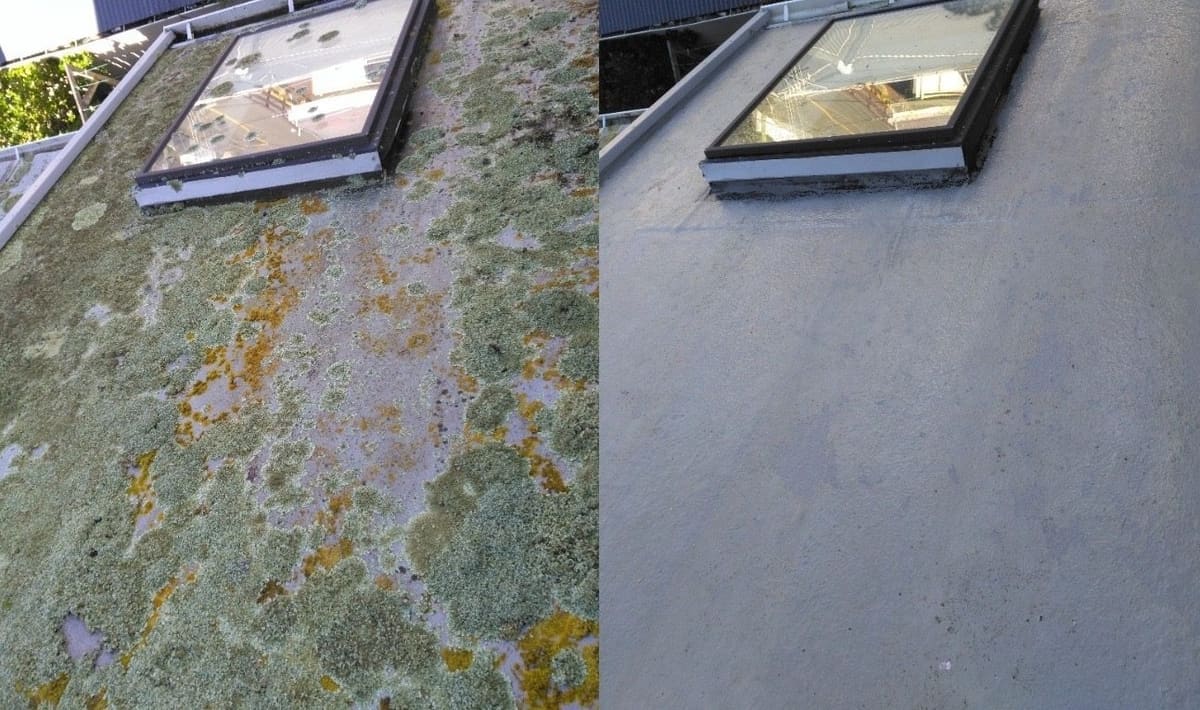
1. Biocide soft wash
The default professional treatment. A biodegradable biocide is applied to the moss-affected surface via low-pressure spray (200–500 PSI), allowed to dwell for 15–45 minutes depending on growth density, then rinsed clean.
What it does: kills moss, lichen and algae at the root. Treated surfaces show visible blackening within 2–4 days as the organisms die, then are washed off (or weather off) over the following 4–8 weeks.
Best for: Painted weatherboard, plaster, concrete tile roofs, Decramastic roofs, terracotta, painted brick. Most Wellington residential surfaces.
Pressure-safe: Yes. The mechanism is chemistry, not pressure.
Lasts: 12–18 months in Wellington, longer in dry inland suburbs, shorter in shaded valley properties (Aro Valley, Karori, parts of Brooklyn).
2. Residual spray (preventer)
A water-borne biocide formulated to leave a residual surface coating that suppresses regrowth. Wet & Forget, Spray & Walk Away, NoMoreGaps Roof are the consumer-grade examples; commercial product is similar with higher active concentration.
What it does: kills surface contamination and prevents new growth taking hold for 6–18 months depending on product and exposure.
Best for: Maintenance between full cleans. NOT effective at clearing heavy existing growth on its own.
Pressure-safe: N/A, applied via low-pressure sprayer.
Lasts: 6–18 months of suppression. After that, regrowth resumes.
3. Manual scrape
Mechanical removal of lichen and moss using a stiff-bristle brush, scraper, or roof-walk brush. No chemistry.
What it does: physically removes visible growth from the surface.
Best for: One specific case, heavy lichen on Coloursteel roofing. Coloursteel’s surface coating tolerates careful brushing better than chemistry penetration. Used as a pre-treatment before biocide.
Pressure-safe: N/A, no pressure used.
Lasts: Not a lasting treatment. The lichen returns from spores remaining in the substrate within 6–12 months. Manual scrape is a step, not a finish.
The honest method: soft wash (biocide + low pressure + dwell + rinse) is the workhorse method for 95% of Wellington moss work. The other two methods exist for specific cases, they're not interchangeable substitutes.
Which method for which surface
| Surface | Right method | Why |
|---|---|---|
| Concrete tile roof | Biocide soft wash | Penetrates the porous tile surface |
| Decramastic roof | Biocide soft wash | Same as concrete tile, no pressure damage |
| Coloursteel roof | Soft wash + manual scrape for heavy lichen | Surface coating intolerant of high pressure |
| Terracotta tile | Biocide soft wash | Soft wash; high pressure damages glaze |
| Painted weatherboard wall | Biocide soft wash | High pressure damages paint adhesion |
| Plaster wall | Biocide soft wash | Plaster is porous, pressure damages |
| Brick (painted or natural) | Biocide soft wash | Pressure displaces mortar |
| Concrete driveway/path | Higher-pressure rinse + biocide | Substrate tolerates pressure well |
The pattern is consistent: on Wellington residential surfaces, the answer is almost always biocide soft wash. The exception is hard, unpainted concrete (driveways, paths) where a higher-pressure water rinse is faster and more effective than chemistry.
Wellington-specific moss patterns
After 25 years cleaning Wellington exteriors, the moss patterns map cleanly to the city’s geography:
Aro Valley, Brooklyn south slopes, Newtown south-facing walls. Heaviest moss growth in the city. South-facing aspects get the least sun, southerly winds carry the most moisture. 6-month treatment cycle isn’t unusual.
Karori, Khandallah, Wadestown high slopes. Heavy lichen rather than moss. Coloursteel roofs in these suburbs accumulate orange-brown lichen patches that require the soft-wash + scrape combination.
Eastern bays, Miramar, Seatoun. Salt + moisture mix. Moss is moderate but mould and algae on weatherboard is heavy. Biocide soft wash + salt-neutralising rinse is the right combination.
Tawa, Johnsonville, northern bowl suburbs. Moderate moss, more pollen and bird-debris. Annual treatment cycle is typical.
Hutt Valley (Lower Hutt, Upper Hutt). Lighter moss than central Wellington, but heavier roof moss on properties with mature trees overhead.
Kapiti Coast. Less moss, more salt-driven mould. Different chemistry on the rinse.
What each treatment costs
These are honest ranges for Wellington residential properties, actual quotes depend on access, surface area, growth density, and roof pitch.
| Treatment | Typical cost (Wellington residential) |
|---|---|
| Soft wash, house exterior only | $250–$650 |
| Soft wash, roof only | $350–$850 |
| Soft wash, house + roof bundle | $550–$1,200 (save 15–20% vs separate) |
| Residual spray (preventer), house exterior | $180–$380 |
| Residual spray, roof only | $250–$520 |
| Manual scrape, Coloursteel roof, heavy lichen | $400–$1,100 (depends on roof size + lichen density) |
For most Wellington homeowners on a normal maintenance schedule, an annual house+roof soft wash bundle at around $750–$950 is the right answer. Coastal properties or heavily shaded ones go to 6-month cycles. Anything more frequent isn’t usually justified.
How long results actually last
The marketing claim is “lasts 2 years.” The honest Wellington answer:
- Inland sheltered, north-facing main roof: 16–24 months before re-treatment is visible
- Inland exposed, mixed aspect: 12–18 months
- South-facing valley: 10–14 months
- Coastal exposure + south-facing: 8–12 months
A residual spray applied 4–6 months after the full soft wash typically extends the maintenance interval by another 4–6 months. For homeowners on a budget, that two-step approach (full clean in autumn + cheaper residual spray in spring) often costs less annually than two full cleans.
What James does
Standard treatment is biocide soft wash, low-pressure application, weather-aware scheduling so the chemistry has dwell time before rain. Salt-neutralising chemistry for coastal properties, biocide-only for inland. Before-and-after photos on every job.
Where Coloursteel roofs need the scrape + soft-wash combination, that’s costed separately because it takes longer.
Residual sprays are offered as a follow-up booking for homeowners who want to stretch the interval, about 4–6 months after the main treatment.
Get a quote or see the moss and lichen treatment service for the service detail.
James, Clear Water Blasting Services.
Written by James · Clear Water Blasting Services
Owner-operated since 2001 from Johnsonville. James does every quote and every job himself across Wellington, the Hutt, Kapiti, Porirua and the Wairarapa.
From the blog
Most recent posts
Is water blasting safe for paint? The straight answer.
Short answer: no, not on a painted house. Long answer involves PSI, paint age, paint type and what soft washing does instead. The full guide for Wellington homeowners.
Read → The Wellington homeowner's pre-sale exterior checklist
Real-estate agents agree on one thing: a clean exterior lifts offers. Here's the exact pre-sale checklist for Wellington homes, what to do, when to book it, and what to skip.
Read →
House washing in Wellington's coastal suburbs, Lyall Bay, Kilbirnie, Seatoun, Island Bay and Miramar
Why coastal Wellington homes age twice as fast, and what to do about it. A practical guide to salt-spray, southerly exposure and the cleaning regime that actually works.
Read →


